
Tick Immunity Symposium returns in 2026
- May 1
- 5 min read
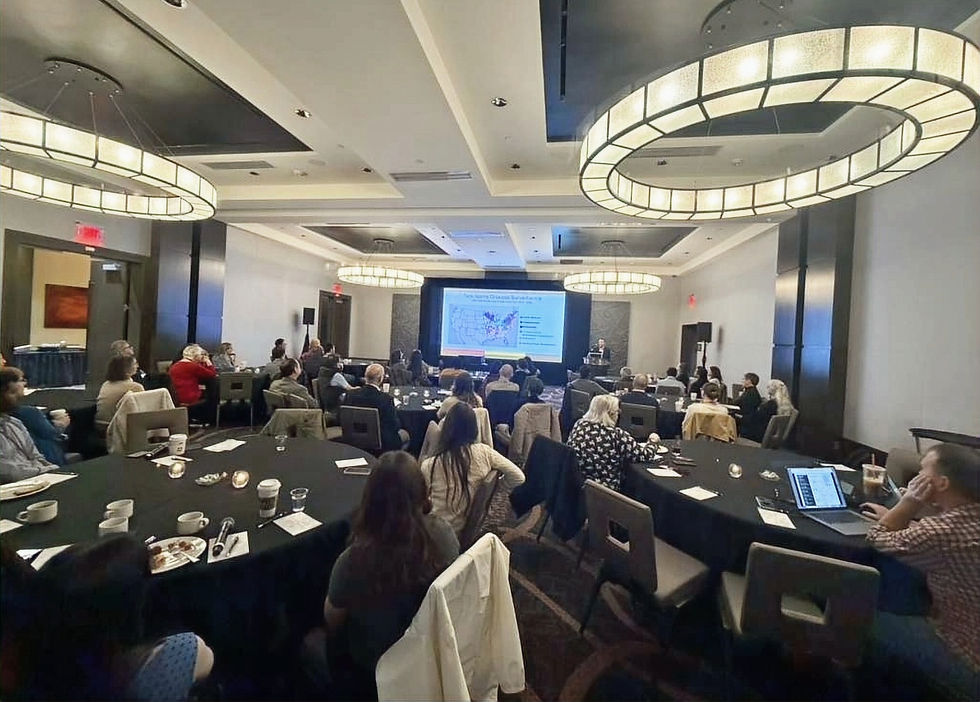
On March 12, roughly sixty attendees gathered in the Terrapin Ballroom of The Hotel at The University of Maryland in College Park, for the 2026 Tick Immunity Symposium*. The event brought together participants from several leading institutions across the United States – spanning Connecticut, Georgia, Idaho, Maryland, Massachusetts, Minnesota, New York, and Pennsylvania – altogether representing a dynamic blend of academia (state universities, Ivy League institutions, and premier private colleges) and federal agencies, including multiple divisions of the NIH. There was an exciting mix of world-renowned experts in infectious diseases and vector biology, emerging researchers who are already breaking ground in the field, and young trainees, including graduate students who are just entering this profession. Also in attendance were the vector biology and Lyme disease Program Officers from NIAID, in addition to the P01’s Scientific Advisory Board, comprised of Drs. Jorge Benach (Stony Brook University), Linda Bockenstedt (Yale School of Medicine), Steve Dumler (Uniformed Services University of the Health Sciences), and Sam Telford (Tufts University).
To begin the event, Dr. Utpal Pal, lead Principal Investigator of the grant, welcomed Dean Wendy Powers of UMD’s College of Agriculture and Natural Resources, who delivered opening remarks. Next, Dr. Pal guided the attendees through an overview of the NIH P01-funded Tick Immunity project. By showcasing the importance of tick-borne diseases around the world, especially highlighting Ixodes ticks as prominent disease vectors, Dr. Pal set the stage for this P01 grant, its goals, and its contributions to the community. The audience was given a preview of the grant’s three Scientific Projects, Administrative Core, and Tick Resources Core, including their major accomplishments in the first award cycle and ongoing work throughout the past year.
The spotlight then focused on Project 1, which is led by Dr. Pal at UMD and is centered on tick signaling pathways, particularly in the context of immune-developmental events. Dr. Pal shared new structural data of the complex between tick Dome1 and mammalian IFNγ – an exciting continuation to the novel cross-species signaling story that was identified and described in the first P01 cycle. Dr. Vipin Rana, Assistant Research Professor in the Pal Lab, shared additional Project 1 updates, including promising results on transcription factors that are involved in tick signaling pathways and that impact tick biology.
Project 2 was presented next, as led by Co-PI Dr. Joao Pedra. His team at the University of Maryland School of Medicine has been tasked with the investigation of tick metabolic pathways and regulation of tick immune responses. Dr. Pedra posed the question of why some microbes (namely, tick-borne diseases) are harmful to humans but not ticks – paving the way for his team’s Project 2 studies. Their results included RNA sequencing of immune cells, the effects of nucleotide metabolism on tick survival, and the effects of select hormones on tick development.
Dr. Sukanya Narasimhan, one of the grant’s Co-Investigators, took the floor to discuss Project 3. Led by Co-PI Dr. Erol Fikrig at the Yale School of Medicine, their proposed goal is to investigate tick immune-developmental and metabolic pathway components as anti-tick vaccine targets. During the first cycle of this grant, Dr. Fikrig’s group created a yeast display library-based technology that can probe for tick-pathogen or tick-host interactions – called IscREAM. Dr. Narasimhan spoke about their use of IscREAM and immunoscreens to identify proteins as potential targets of anti-tick vaccines.
The P01-centric portion of the day concluded with updates from the Tick Resources Core. Led by Dr. Jonathan Oliver at the University of Minnesota, the purpose of the Core is to provide and develop vector-based and tick cell-based tools and technologies, both for the P01 team and the wider community. Dr. Oliver, along with Co-Investigator Dr. Benjamin Cull, described their ongoing efforts, such as technologies for artificial membrane feeding. They also showcased various resources from the Tick Core that are currently available for others in the scientific community.
After a lunch break, the audience was treated to an impressive and engaging slate of guest presentations. Dr. Shirley Luckhart from the University of Idaho, the event’s keynote speaker, delivered a talk inspired by renowned biologist George Bartholomew. She spoke about several diverse points of focus that she has explored in her work on mosquitoes and malaria. Dr. Luckhart’s passion for vector biology and enthusiasm for interspecies comparisons were a perfect complement to this symposium. The session continued with wonderful guest presentations from Dr. Norbert Perrimon from Harvard University, who discussed his expertise in CRISPR screens in arthropods, and Dr. Travis Glenn from the University of Georgia, who spoke about his extensive work on comparative tick genomics. Both Drs. Perrimon and Glenn highlighted methods for their respective technologies, and how these could be applied to broader tick biology research.
As a grand finale to the symposium, nine trainees were given the floor for a “Lightning Talks” session, moderated by Dr. Chrysoula Kitsou from the Pal lab. A series of rapid-fire presentations were provided by doctoral students, postdocs, and junior scientists from the P01 project sites and other collaborators. Topics included host-vector interactions, skin immunity, sequencing, novel strategies for antibacterials or anti-tick vaccines, small RNAs in mammalian infection, and signaling pathway components. It was an exciting, fast-paced conclusion to the symposium, allowing the audience to hear from scientists-in-training about a diverse set of studies.
Altogether, the P01 presentations not only conveyed promising results from the ongoing grant work, but also showcased the team’s generation of important resources for the community at large. This includes the improved I. scapularis genome from the Pal lab, which is the current reference genome for the species and thus serves as the foundation for a multitude of vector-based studies – as mentioned in Dr. Glenn’s guest presentation – as well as the IscREAM platform and related technology from the Fikrig group, which other laboratories are encouraged to utilize for interaction studies on a broad scale. Optimized protocols and resources for single-cell sequencing and high-throughput CRISPR screens, as developed in Dr. Pedra’s and Dr. Perrimon’s laboratories, were also highlighted.
Another major takeaway of the symposium was its collaborative spirit – not just within the P01 team for the purposes of this grant, but also with other scientists from complementary disciplines around the world, not to mention with junior researchers and trainees who are just dipping their toes into this field. It was evident that this group of attendees valued one another’s insights, experiences, and feedback, and that everyone was eager to learn from and encourage each other in their pursuits. The symposium was clearly a wonderful vessel to foster collaboration, encourage the next generation, and serve the wider research community.
*We gratefully acknowledge the National Institutes of Health, National Institute of Allergy and Infectious Diseases, for its funding of the Program Project P01 grant (P01AI138949), which made this symposium possible.
Symposium Organizing Committee: Kathryn Nassar, Chrysoula Kitsou, and Utpal Pal


Comments